
Why Agentic AI Is the Future of Customer Retention in 2026

Why Agentic AI Is the Future of Customer Retention in 2026
Customer retention in 2026 will no longer be won by static journeys, rule-based workflows, or delayed campaigns. The brands that grow fastest will be the ones that can sense customer intent, decide the next-best action, and act instantly across channels.
That’s exactly why Agentic AI for customer retention is becoming the defining growth engine for modern businesses in 2026. Unlike traditional AI that only recommends, Agentic AI can autonomously analyze behavior, predict churn, trigger personalized rewards, recover at-risk users, and continuously learn from outcomes.
Industry trends show 2026 as the year AI agents move from pilot projects to real business workflows, especially in customer experience and retention.
For loyalty, subscription, fintech, ecommerce, and SaaS brands, this shift is not optional—it’s the future of profitable retention.
What Is Agentic AI in Customer Retention?
Agentic AI refers to autonomous AI systems that can observe, reason, decide, and take action toward a defined retention goal.
In customer retention, this means the AI does not stop at identifying churn risk. It moves further by:
- Detecting customer drop-off signals
- Predicting churn probability
- Choosing the best retention intervention
- Triggering rewards, offers, emails, or nudges
- Measuring the result
- Learning which action improved lifetime value
This is a major evolution from reactive automation to goal-driven retention intelligence.
Traditional AI vs Agentic AI
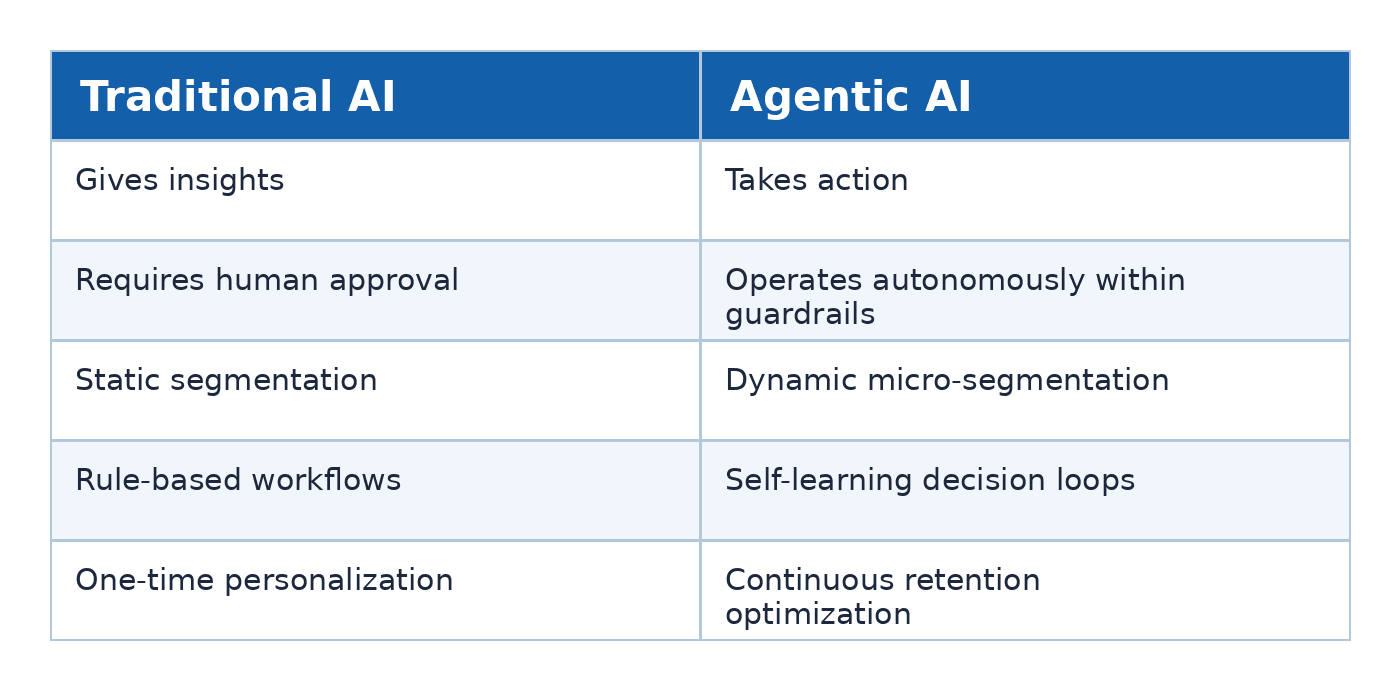
Why Agentic AI Is the Future of Customer Retention in 2026
The biggest reason is simple: customer behavior changes faster than manual teams can respond.
By 2026, brands need systems that can respond in milliseconds, not marketing cycles.
1) Real-Time Churn Prevention
Agentic AI continuously tracks:
- Drop in product usage
- Reduced order frequency
- Reward inactivity
- Lower engagement rates
- Payment failures
- Negative support sentiment
The moment churn intent is detected, it can instantly trigger:
- Personalized loyalty points
- Cashback boosters
- Win-back emails
- In-app nudges
- VIP support routes
- Surprise rewards
This reduces churn before the customer is fully lost.
2) Hyper-Personalized Reward Decisions
Not every reward creates revenue.
Agentic AI helps brands move from blanket discounts to profitable retention actions by deciding:
- Who should receive a reward
- What type of incentive works best
- When to deliver it
- Which channel converts best
- How much margin can be protected
This aligns perfectly with the Sense → Decide → Act → Learn retention framework.
3) Autonomous Retention Journeys
In 2026, leading retention teams will no longer build dozens of manual workflows.
Instead, AI agents will autonomously orchestrate journeys like:
- Dormant user recovery
- Churn-risk reward campaigns
- Post-purchase loyalty activation
- High-LTV VIP protection
- Subscription renewal nudges
- Personalized milestone rewards
This is where Reward Rally Agentic AI becomes especially powerful: turning retention into an intelligent decision layer.
Key Use Cases of Agentic AI for Retention Teams
Here are the most valuable real-world use cases.
Predictive Loyalty Optimization
The AI predicts which users are likely to disengage and adjusts:
- Reward thresholds
- Points expiry reminders
- Redemption recommendations
- Tier progression nudges
Subscription Renewal Recovery
For SaaS and subscription brands, Agentic AI can:
- Identify users likely to cancel
- Analyze feature adoption gaps
- Push relevant onboarding content
- Offer usage-based renewal incentives
- Escalate accounts to CSM teams
Ecommerce Repeat Purchase Acceleration
AI agents analyze purchase cycles and autonomously launch:
- Replenishment reminders
- Dynamic cross-sell rewards
- Bundle offers
- Loyalty streak campaigns
- Cart recovery incentives
These retention loops drive higher repeat purchase rates and CLV.
How Agentic AI Improves Customer Lifetime Value
Customer retention is ultimately about maximizing customer lifetime value (CLV).
Agentic AI improves CLV through:
- Lower churn rates
- Increased repeat purchases
- Smarter reward spend
- Better retention ROI
- Improved loyalty participation
- Reduced campaign waste
- Faster customer recovery
The result is profitable retention, not just engagement metrics.
Practical Example
Imagine a fintech app user who suddenly stops transacting.
Traditional automation:
Sends a generic “We miss you” email after 7 days.
Agentic AI:
- Detects transaction decline in real time
- Checks historical behavior
- Predicts 82% churn risk
- Sends a personalized cashback challenge
- Follows up with milestone rewards
- Escalates to WhatsApp reminder if unopened
- Learns which offer drove reactivation
That’s the future of autonomous retention.
SEO-Friendly Best Practices for Brands Adopting Agentic AI
If you want to implement Agentic AI successfully in 2026, focus on:
1) Unified Customer Data
Retention AI needs connected data across:
- CRM
- Loyalty systems
- App events
- Support
- Transactions
- Email engagement
- Reward redemptions
2) Decision Guardrails
Autonomy needs governance.
Define:
- Budget limits
- Reward caps
- Churn thresholds
- Escalation rules
- Compliance policies
3) Continuous Learning Loops
The best systems optimize every action outcome:
- Redeemed
- Ignored
- Churned
- Reactivated
- Upsold
This creates a compounding retention advantage.
Conclusion
The future of retention belongs to brands that can move from reactive campaigns to autonomous customer decisioning.
That’s why Agentic AI for customer retention is set to dominate 2026. It empowers businesses to predict churn, trigger intelligent rewards, personalize every journey, and continuously learn what drives long-term loyalty.
As enterprise AI shifts from pilots to embedded workflows in 2026, retention will become one of its highest-ROI use cases.