
Traditional Loyalty vs AI Loyalty: Retention Results from a D2C Apparel Brand
Introduction
A customer visits an apparel store late at night and spends several minutes browsing oversized hoodies. She carefully checks reviews, explores product variants, adds two products to her cart, and then exits the website without making a purchase.
In most traditional loyalty systems, this interaction would trigger a generic abandoned cart email several hours later offering a discount incentive. The system reacts only after the customer leaves and treats every abandoned cart in the same way.
However, modern customer behavior is far more nuanced. A customer may hesitate because of sizing uncertainty, return concerns, price comparison, lack of confidence, or simply because the engagement experience feels impersonal.
Traditional loyalty systems cannot understand these behavioral signals. They follow predefined automation rules without context or intelligence.
This is where AI-powered loyalty changes the customer retention experience entirely.
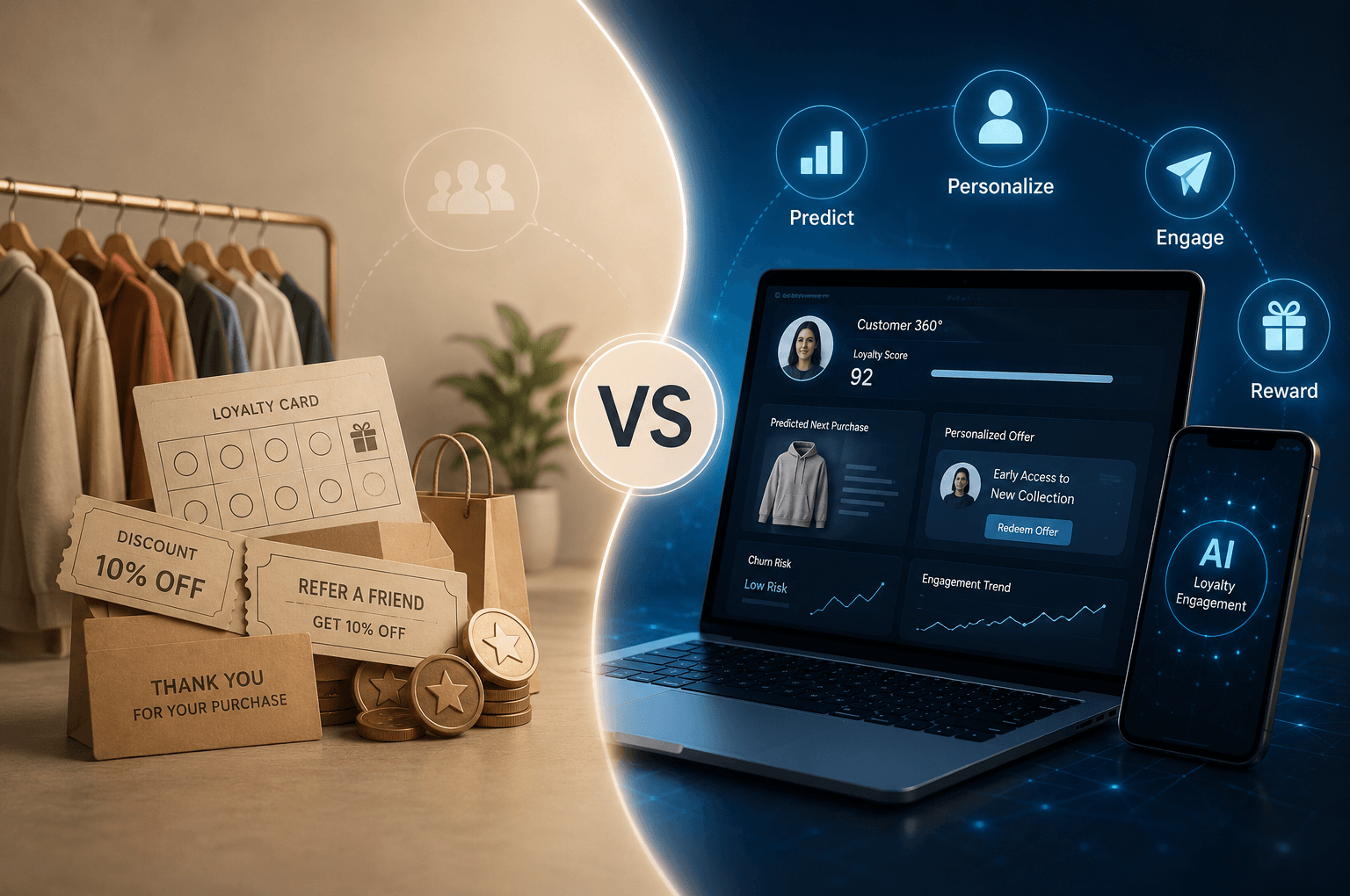
Reward Rally Agentic AI Loyalty enables D2C brands to move beyond static loyalty programs by continuously understanding customer behavior, predicting disengagement, and autonomously delivering personalized retention experiences in real time.
For modern apparel and fashion brands, this shift is becoming essential for sustainable growth.
The Growing Retention Problem in D2C Fashion
Most D2C apparel brands focus heavily on customer acquisition. Marketing teams invest continuously in paid advertising, influencer campaigns, SEO, and performance marketing to increase traffic and generate first-time purchases.
While acquisition metrics may improve, retention often becomes the hidden challenge.
Customers purchase once and quietly disappear. In many cases, this does not happen because the products are poor or because the marketing failed. The real issue is that the relationship between the customer and the brand ends after the transaction.
Traditional loyalty programs were originally designed to solve this problem using reward points, cashback systems, discount offers, referral campaigns, and birthday rewards. For years, these strategies helped brands encourage repeat purchases and improve customer engagement.
However, customer expectations have changed significantly.
Modern shoppers expect brands to understand their preferences, recognize their behavior, and engage with them in a way that feels personalized and relevant. Generic rewards and mass promotional campaigns are no longer enough to build long-term loyalty.
Customers now expect experiences rather than simple incentives.
Why Traditional Loyalty Systems Are Becoming Ineffective
Traditional loyalty platforms operate using fixed automation workflows. A customer completes a purchase, and points are assigned. A customer becomes inactive, and a coupon campaign is triggered. A cart is abandoned, and an email reminder is automatically sent.
These systems are reactive by design.
They respond after an event occurs rather than understanding the intent behind customer behavior. More importantly, they cannot identify emotional or behavioral signals that influence purchasing decisions.
Different customers disengage for completely different reasons. Some hesitate because of pricing concerns. Others lose interest because the communication feels repetitive or irrelevant. Some simply shift toward competitors that provide more personalized experiences.
Traditional loyalty systems lack the intelligence required to identify these patterns in real time.
As a result, many D2C brands experience increasing customer acquisition costs, declining repeat purchase rates, growing discount dependency, unpredictable retention performance, and higher churn rates. Marketing teams often attempt to compensate by sending more campaigns, increasing promotional frequency, or offering larger discounts, but these approaches rarely solve the core retention problem.
The issue is not the lack of campaigns.
The issue is the lack of customer understanding.
Moving Beyond Traditional Loyalty with Reward Rally Agentic AI
To overcome these retention challenges, the apparel brand implemented Reward Rally Agentic AI Loyalty, an AI-powered retention platform designed to continuously learn from customer behavior and autonomously optimize engagement strategies.
Unlike traditional loyalty systems that rely on static workflows, Reward Rally continuously monitors real-time customer activity and behavioral signals. The platform analyzes browsing behavior, engagement frequency, product interest patterns, churn indicators, and purchasing intent to determine how customers are interacting with the brand.
Instead of waiting for customers to disengage completely, the AI proactively predicts retention risks and identifies the most effective engagement strategy for each individual customer.
This allows brands to move from reactive loyalty management to predictive and intelligent customer retention.
Traditional Loyalty vs Reward Rally Agentic AI Loyalty
| Traditional Loyalty Systems | Reward Rally Agentic AI Loyalty |
|---|---|
| Reactive campaign execution | Predictive customer retention |
| Fixed automation workflows | Self-learning AI-driven decisions |
| Generic reward systems | Personalized loyalty experiences |
| Manual customer segmentation | Real-time behavioral intelligence |
| Broad discount campaigns | Context-aware engagement |
| Delayed churn response | Early churn prediction |
| Static customer journeys | Autonomous adaptive journeys |
| Manual monitoring and optimization | Continuous AI-driven intelligence |
| Transaction-focused engagement | Relationship-focused engagement |
| One-size-fits-all communication | Hyper-personalized customer interactions |
| High operational effort | Intelligent automation at scale |
How AI-Powered Loyalty Improved Customer Engagement
Within weeks of implementing Reward Rally, the apparel brand began experiencing noticeable improvements in customer engagement and retention behavior.
Inactive customers who had previously stopped engaging with the brand started returning organically. Unlike traditional retention campaigns that relied heavily on discounts, the engagement experience now felt more personalized and relevant to each customer’s preferences and behavior.
For example, some customers received personalized styling recommendations based on their browsing history and product interests. Others were invited to early-access launches aligned with their previous purchases and shopping preferences. High-value customers showing early disengagement signals were proactively re-engaged before fully churning.
These retention actions were not manually configured workflows. They were generated through AI-driven behavioral intelligence that continuously adapted based on customer interactions.
The loyalty experience became significantly more human, contextual, and intelligent.
The Intelligence Framework Behind Reward Rally Agentic AI
Reward Rally Agentic AI operates through a continuous four-stage intelligence framework that enables autonomous customer retention optimization.
Sense
The platform continuously monitors customer interactions, engagement patterns, browsing behavior, and behavioral changes across the customer journey in real time.
Decide
Using behavioral intelligence and predictive analysis, the AI identifies customers who may be at risk of disengagement and determines the most effective retention strategy for each individual.
Act
Personalized engagement experiences, retention campaigns, and loyalty interactions are automatically triggered across relevant customer touchpoints.
Learn
Every customer interaction improves future decision-making. The platform continuously refines its understanding of customer behavior, allowing retention performance to improve over time.
This creates a self-learning loyalty ecosystem capable of becoming smarter and more effective with every interaction.
Business Results After Implementing Reward Rally
The transition from traditional loyalty systems to AI-powered retention generated measurable business impact for the apparel brand.
The company achieved a significant increase in repeat purchases as customers began engaging more consistently with personalized experiences rather than generic promotional campaigns. Customer retention rates improved substantially because the platform identified churn risks early and proactively recovered at-risk customers before disengagement became permanent.
The brand also reduced its dependence on aggressive discounting strategies. Instead of relying on constant coupon campaigns to drive repeat purchases, the company improved retention through relevance, personalization, and intelligent engagement.
Operational efficiency improved as well. Marketing teams no longer needed to manually analyze customer behavior or continuously optimize static workflows. The AI autonomously monitored customer interactions and optimized retention decisions in real time.
As customer relationships strengthened, overall customer lifetime value increased, creating more sustainable long-term profitability for the business.
Why Agentic AI Loyalty Matters for Modern D2C Brands
Many D2C brands continue addressing retention problems through traditional marketing tactics such as increasing email frequency, running more SMS campaigns, or offering additional discounts.
However, the future of customer retention is not about sending more promotional messages.
It is about delivering the right experience at the right moment automatically.
Modern customers expect brands to understand their preferences, anticipate their needs, and engage with them in ways that feel relevant and personalized. Brands that fail to provide these experiences often struggle with disengagement, declining loyalty, and rising acquisition costs.
Reward Rally Agentic AI helps brands shift from reactive retention management to proactive relationship building. Instead of waiting for customers to churn, the platform continuously protects customer relationships through predictive intelligence and autonomous engagement optimization.
As customer acquisition costs continue to rise across the D2C industry, retention has become one of the most critical drivers of long-term business growth.
The Evolution of Customer Loyalty
Customer loyalty is no longer built solely on reward points, discount codes, or cashback programs.
Modern loyalty is driven by intelligent customer experiences and personalized brand relationships.
Today’s customers switch brands faster, expect personalization immediately, ignore irrelevant communication, and disengage silently when experiences fail to feel meaningful. Static loyalty systems designed around generic automation workflows are becoming increasingly ineffective in this environment.
The future belongs to brands that can continuously understand customer intent, personalize engagement autonomously, and optimize retention using AI-driven intelligence.
This is the foundation of Agentic AI Loyalty.
Conclusion
For D2C apparel brands struggling with low repeat purchases, rising churn, increasing customer acquisition costs, discount dependency, and unpredictable retention performance, traditional loyalty strategies are no longer sufficient.
The solution is not simply running more campaigns or offering larger discounts.
The solution is building smarter customer retention systems powered by behavioral intelligence and autonomous AI decision-making.
Reward Rally Agentic AI Loyalty enables brands to move beyond transactional loyalty programs and create intelligent, personalized customer relationships at scale. By combining predictive retention intelligence, real-time behavioral analysis, and autonomous engagement optimization, brands can improve retention performance, strengthen customer loyalty, and drive sustainable long-term growth.
The future of customer retention is no longer traditional loyalty systems.
The future is Reward Rally Agentic AI Loyalty.